If you’ve ever tried on a lace wig, leaned closer to the mirror, and thought
“Why does my hairline look… dotted?”
you’re not alone.
Those tiny dark points near the lace front are often blamed on scalp issues, lace quality, or even “bad hair.”
But in many cases, the real reason is much smaller—and much more technical.
It’s the knots.
And more specifically: how knot size, knot density, and hair color work together to trick your eyes.
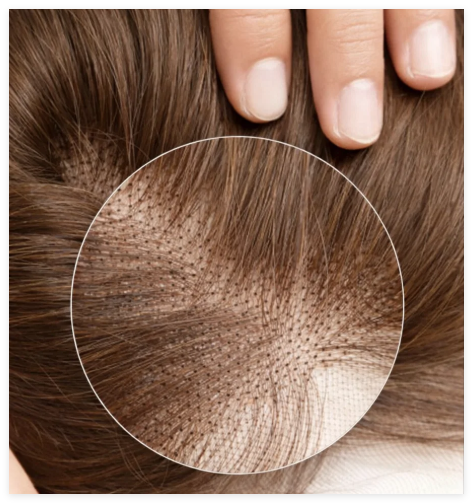
Black dots ≠ scalp problem
Let’s clear this up first.
Those dark dots you see are not pores.
They’re not dirt.
And they’re usually not a sign that the lace itself is low quality.
What you’re actually seeing is the base of the hair knot, magnified by contrast and density. Once you understand that, a lot of “unnatural hairline” complaints suddenly make sense.
Knot size: small difference, big visual impact
Knot size matters more than most people expect.
Larger knots anchor more hair at a single point. Structurally, that’s strong—but visually, it creates a darker spot, especially along the hairline where light hits directly.
Smaller knots spread that same hair weight more evenly.
They don’t shout for attention.
They blend.
That’s why two wigs with the same lace can look completely different once worn. The difference isn’t the lace—it’s the knots sitting on top of it.
Density can exaggerate everything
Here’s where things get sneaky.
Higher density doesn’t just mean “more hair.”
It means more knots per square inch.
When density goes up, knots sit closer together. Even if each knot is reasonably small, your eye starts grouping them visually. The result? A shadowed effect that reads as dots or dark areas—especially at the front.
This is why a wig can look perfect on a mannequin, but suddenly feel “heavy” or “wiggy” on a real head under natural light.
More hair isn’t always the answer. Sometimes it’s the problem.
Dark hair makes knots louder
Color changes everything.
With darker hair shades—natural black, off-black, deep brown—the knot base has stronger contrast against the lace. No matter how fine the work is, dark pigment reflects less light. Your eyes notice it faster.
This is also why the same wig construction can look flawless in lighter colors but “spotty” in darker ones.
It’s not inconsistency.
It’s physics.
So what actually creates a natural hairline?
It’s rarely one single factor.
A natural-looking hairline usually comes from a balance:
- Smaller or well-controlled knot size
- Thoughtful density at the front (often lighter than the back)
- Hair color choices that match knot treatment
- And yes—proper bleaching or knot refinement where appropriate
When one of these is off, the illusion breaks.
And most of the time, what people call a “lace problem” is actually a knot visibility problem.
A natural hairline isn’t luck.
It’s the result of dozens of small, deliberate choices working together.
When knots are handled with intention, dark dots fade into the background—and the hairline starts doing what it should: disappear.
The more you learn to look past the surface, the more control you gain over the final result.
And that’s where real quality starts to show.